Home > News > Flood Submerges Abuja’s Asokoro, Maita...
Flood Submerges Abuja’s Asokoro, Maitama and Guzape as Wike Orders Demolitions
By AnchorNews | 23 Aug, 2026 06:45:09am | 88
By Sandra Ugwu
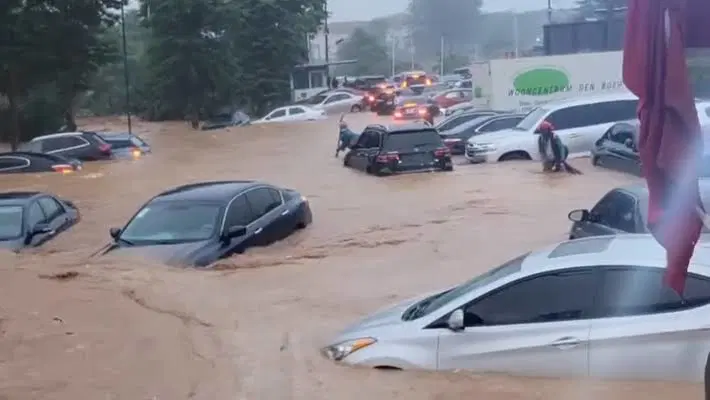
ABUJA - A devastating flood has swept through some of Abuja’s most affluent districts, leaving homes, businesses, vehicles and infrastructure damaged and forcing the Federal Capital Territory Administration to launch a fresh crackdown on structures built on waterways and the misuse of protected green spaces.
The unprecedented downpour on Tuesday night submerged parts of Asokoro, Maitama, Guzape, Garki, Wuse and other areas, with residents describing the flooding as one of the worst they had experienced in the capital in recent years.
In several residential areas, floodwater entered homes and compounds, destroyed household possessions and swept away fences and other structures. In Asokoro, residents reported water reaching unusually high levels, while in Maitama, families were forced to move upstairs as floodwater entered their homes.
Guzape, one of Abuja’s rapidly developing high-end districts, was also badly affected. Construction sites were flooded, while building materials, including cement, reinforcement rods and tiles, were destroyed. Some newly completed properties also suffered damage as water overwhelmed existing drainage routes.
The scale of the flooding has triggered renewed concerns about Abuja’s urban planning, drainage infrastructure and the development of properties along natural waterways.
FCT Minister, Nyesom Wike, has responded by ordering the demolition of any structure found standing on a water channel, regardless of its ownership. The directive followed his assessment of some of the affected areas and concerns over the obstruction and abuse of waterways.
Demolition teams subsequently moved into parts of Maitama, including Mississippi Street and surrounding areas, with bulldozers, cranes, tippers and security personnel deployed to remove structures identified for demolition.
Some property and business owners, however, complained about the manner in which the exercise was conducted. Mustapha Onimisi, owner of Xpressor, said they had initially been informed that their properties would be marked and that they would be given two weeks to remove valuables before demolition. He said they were surprised when the demolition commenced earlier than expected.
Beyond the demolition of structures on waterways, the FCT Administration has also banned the conversion of green spaces, parks and gardens into commercial car dealership lots across Abuja.
The administration said the measure was necessary because the loss of designated green and absorption areas has affected the capital’s drainage system and contributed to worsening flood risks. A dedicated task force has been established to monitor the affected areas and enforce the removal of illegal car lots.
The government has also commenced an administrative investigation into officials suspected of issuing illegal approvals for commercial activities on protected spaces.
Engineers and urban planners have attributed the flooding to a combination of factors, including the intensity of the rainfall, inadequate drainage capacity, blocked channels and uncontrolled development.
More than 90mm of rainfall was reportedly recorded in less than four hours, while several drainage systems in the city centre were described as outdated and heavily silted. Development on hills and natural water paths, particularly around Guzape, has also altered the movement of stormwater.
Critics have further accused successive authorities and developers of allowing green areas, open spaces and waterways to be reduced or converted for other uses, potentially leaving the city with fewer natural routes for managing stormwater.
The flooding has left residents demanding more than emergency interventions and demolition exercises. Many are calling for regular drainage maintenance, the expansion and upgrading of existing drainage infrastructure, strict enforcement of Abuja’s master plan and the protection of natural waterways and green spaces.
Residents also want authorities to provide clear assurances about the safety of affected neighbourhoods, particularly as concerns grow over the possibility of another major downpour.
The disaster has changed the way many residents view heavy rainfall. In some residential communities, people are now advising one another to move vehicles to higher ground, protect important documents and prepare for possible flooding whenever dark clouds gather.
The latest disaster has therefore placed Abuja’s rapid urban expansion and planning enforcement under renewed scrutiny. For residents of Asokoro, Maitama and Guzape, the flood has erased the long-held assumption that the capital’s wealthier neighbourhoods are insulated from the consequences of poor drainage, blocked waterways and uncontrolled development.
As the city begins to recover, the major question is whether the measures announced by the Wike administration will be sustained long enough to address the underlying causes of Abuja’s flooding—or whether residents will once again be left watching the skies whenever the rains return.

Leave a Reply
Your email address will not be published. Required fields are marked *
Category
 Religion
  Technology
 News
News Politics
.jpeg) Interviews
Interviews Business & Economy
 Crime & Security
 Education
  Sports
  Entertainment
 Culture & Tourism
 Health
 Opinion